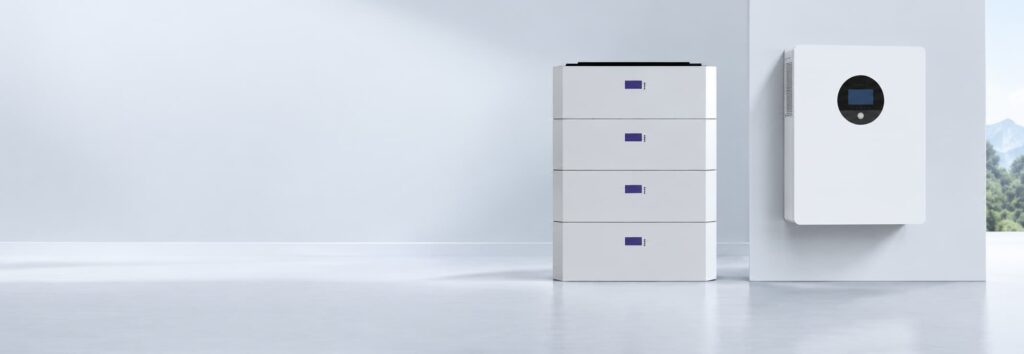
Home energy storage batteries are available in different installation styles. Two common options are stackable battery systems and wall-mounted batteries.
The main difference is not only appearance. Installation space, future expansion, and required system capacity should all be considered before choosing.
What Is a Stackable Home Battery?
A stackable battery system uses separate battery modules that are placed on top of each other.
The supplied material describes a modular design based on approximately 5kWh battery units. Capacity can be increased by adding more modules, making this type of system suitable when future expansion is important.
For example, a system may start with:
- 5kWh
- 10kWh
- 15kWh
- 20kWh
and expand later if household energy demand increases.
Stackable systems normally use floor space, so installation planning should allow enough room around the battery system.
What Is a Wall-Mounted Home Battery?
A wall-mounted battery is installed directly on a wall.
This format is useful where floor space is limited and the required battery capacity is relatively compact.
Compared with a modular stackable system, expansion may be less flexible depending on the product design. For buyers who already know the required capacity and prefer a compact installation, a wall-mounted battery can be a practical option.
Stackable vs Wall-Mounted Battery Comparison
| Comparison | Stackable Battery | Wall-Mounted Battery |
|---|---|---|
| Installation | Floor stacked | Wall mounted |
| Expansion | Easier | Usually more limited |
| Space use | Uses floor space | Saves floor space |
| Capacity planning | Better for future expansion | Better for compact systems |
| Typical use | Larger home storage systems | Smaller residential systems |
When to Choose a Stackable Battery
A stackable home energy storage battery is usually more suitable when:
- the project may need more capacity later
- the system requires 10kWh, 15kWh, 20kWh or more
- floor installation space is available
- modular expansion is preferred
- the buyer wants to increase capacity without replacing the whole system
The source material specifically notes that stackable batteries can increase system capacity by adding additional battery modules.
This makes them useful for residential projects where future electricity demand may increase.
When to Choose a Wall-Mounted Battery
A wall-mounted battery may be a better fit when:
- installation space is limited
- the system capacity is already clear
- a compact residential installation is preferred
- floor space should remain available
- the project does not require frequent future expansion
For smaller home energy storage systems, this installation style can keep the battery system simple and space-efficient.
Capacity Is Not the Only Difference
Battery format should not be the only selection factor.
Buyers should also compare:
- nominal voltage
- usable capacity
- charge and discharge current
- BMS
- communication protocol
- inverter compatibility
- operating temperature
- expansion limits
A larger stackable system is not automatically better, and a wall-mounted system is not automatically more suitable for every home.
The right choice depends on the required capacity, installation environment, and future expansion plan.
Final Thoughts
The main advantage of a stackable home battery is flexible capacity expansion.
The main advantage of a wall-mounted battery is compact installation.
If the project may expand from 5kWh to 10kWh, 15kWh, or more, a modular stackable system is generally easier to scale. If the required capacity is smaller and installation space is limited, a wall-mounted battery may be more practical.
For B2B buyers and system integrators, the best choice should be based on capacity planning, installation conditions, inverter compatibility, and future system requirements.